Russian
Furnace Insulation Engineering reduces heat loss from 20–30% to 5–10% and achieves 15–25% energy savings by integrating graded insulation structures + high-temperature-resistant materials + standardized construction, while protecting the furnace steel structure and extending service life.
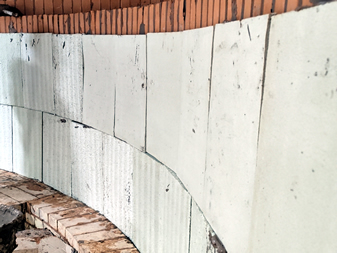
The following explains design principles, material selection, construction workflow, quality control, and common issues.
I. Design Principles (Graded Insulation)
Furnace insulation employs a multi-layer composite structure (inner → outer) balancing high-temperature resistance, low thermal conductivity, thermal shock resistance, and airtightness:
Working Layer (Hot Face)
Direct exposure to high temperatures (≥ operational temperature). Materials:Corundum castable (1,800°C), High-alumina bricks (1,400–1,600°C), Silicon carbide bricks (>1,500°C).
Insulation Layer (Intermediate)
Low thermal conductivity (λ < 0.1 W/m·K). Materials:Ceramic fiber modules/blankets (1,260–1,400°C), Lightweight high-alumina bricks, Calcium silicate boards (1,000°C).
Sealing Layer (Cold Face)
Moisture/gas/corrosion resistance. Materials: High-temperature sealants, Aluminum-foil glass cloth, Galvanized steel sheets.
Key Specifications:
Outer surface temperature ≤50–60°C, Heat flux density ≤850 kcal/m²·h, Expansion joints: 3–5mm/m (filled with fiber).
II. Mainstream Insulation Material Selection (Temperature-Based Zoning)
Material Type | Temperature Resistance Range | Thermal Conductivity (W/m·K) | Applicable Location |
Ceramic Fiber Modules/Blankets | 1260–1400°C | 0.03–0.05 | Kiln crown, walls, flue ducts |
Lightweight High-Alumina Bricks | 1000–1300°C | 0.08–0.15 | Medium-to-high-temperature insulation layers |
Calcium Silicate Boards | ≤1000°C | 0.05–0.10 | Medium-to-low-temperature backings |
Rock Wool/Glass Wool | 400–700°C | 0.04–0.06 | Low-temperature flue ducts, pipelines |
Aerogel Composite Layers | ≤650°C | 0.02–0.03 | Energy-efficient upgrades (thin-layer high insulation) |
III. Standard Construction Procedure (Taking Ceramic Fiber Modules as an Example)
1. Construction Preparation
Furnace Steel Structure Inspection: Remove rust and weld anchor components (heat-resistant steel, spaced 300-500 mm apart).
Material Inspection: Check temperature resistance rating, dimensions, and compression rate (modules pre-compressed by 15%-20%).
Safety Precautions: Wear dust masks, protective clothing, and high-temperature-resistant gloves.
2. Base Layer Preparation
Furnace Wall Cleaning: Ensure the surface is free from oil, rust, and debris.
Anchor Component Welding: Arrange in a quincunx pattern, ensuring secure and solid welds without cold solder joints.
3. Installation of Insulation Layer (from bottom to top, staggered joint laying)
Ceramic Fiber Blanket Base Layer: Thickness: 20-50 mm, Staggered joints: ≥100 mm, Overlap: ≥50 mm, secured with U-shaped nails.
Module Installation: Pre-compress the modules with the packing strap facing outward, align with anchor components, and rotate to lock in place.Ensure tight fitting between modules with gaps ≤2 mm, filled with fiber strips.Cut the packing strap to allow module rebound and expansion, forming an integrated sealed layer.
Expansion Joint Setting: Leave 3-5 mm gaps every 2-3 m, filled with ceramic fiber ropes.
4. Surface Treatment and Protection
Spray High-Temperature Curing Agent/Sealing Coating: Enhance erosion resistance and prevent powder shedding.Outer Layer Wrapping: Use aluminum foil glass cloth or galvanized steel sheets for weatherproofing, corrosion resistance, and securing.
5. Furnace Drying (Critical! Prevent cracking)
Low-Temperature Stage (Room Temperature→200°C): Heating rate: ≤5°C/h, Hold for 24 hours (moisture removal).
Medium-Temperature Stage (200-600°C): Heating rate: ≤10°C/h, Hold for 12 hours (curing).
High-Temperature Stage (600°C→Operating Temperature):Heating rate: ≤15°C/h, Hold for 8 hours every 300°C increment.
IV. Quality Control and Acceptance Criteria
1.Material Acceptance:
Temperature resistance, thermal conductivity, and dimensions must meet design specifications, with certificates and test reports available.
2.Construction Quality:
Anchor Components: Spacing ≤500 mm, securely welded without omissions.
Insulation Layer: No hollow areas, looseness, or significant gaps; staggered/overlapping joints meet standards.
Surface: Smooth, free from powder shedding and cracks, with good sealing.
3.Thermal Performance Acceptance:
Outer Surface Temperature: ≤55°C (at 25°C ambient temperature).
Heat Loss: ≤850 kcal/m²·h.
Infrared Inspection: No hot spots or thermal bridges.
V. Common Issues and Solutions
1.Insulation Layer Detachment:
Causes: Excessive anchor spacing, cold solder joints.
Solutions: Increase anchor density, re-weld; increase module pre-compression to 20%.
2.Excessive Furnace Temperature, High Outer Surface Temperature:
Causes: Insufficient insulation thickness/low-temperature-resistant material.
Solutions: Increase thickness, upgrade material; fill gaps with fiber strips, staggered joint laying.
3.Furnace Drying Cracks:
Causes: Rapid heating.
Solutions: Strictly adhere to the heating curve; supplement expansion joints, fill with fiber.
4.Thermal Bridges (Localized Overheating):
Causes: Heat conduction from anchor components/steel structures.
Solutions: Add ceramic fiber sleeves and thermal insulation pads to anchor components.
VI. Energy-Saving Benefits Reference
Uninsulated: 20%-30% heat loss, high fuel consumption.
Optimized Insulation: 5%-10% heat loss, 15%-25% energy savings, investment recovered in 1-2 years.
Furnace Lifespan: Extended by 30%-50%, reducing maintenance downtime.
VII. Applicable Standards
GB/T16618-1996 General Principles for Thermal Insulation Technology of Industrial Furnaces.
GB50211-2014 Construction and Acceptance Specifications for Industrial Furnace Masonry.
GB/T3003-2017 Refractory Fiber Products.